Research Projects
GHOULS
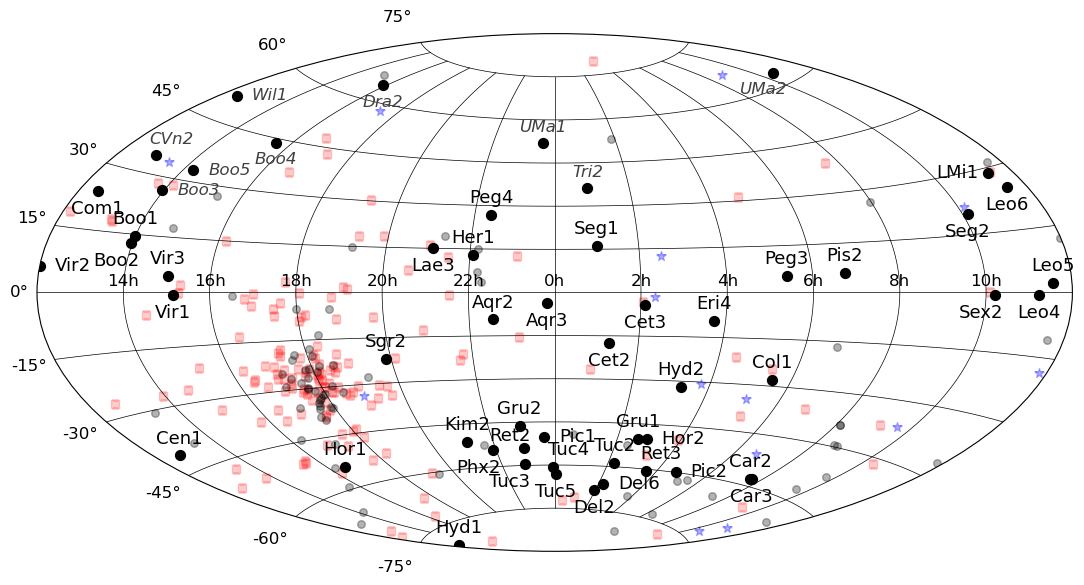
The GHOST Ultrafaint Legacy Survey (GHOULS) is a project focused on studying the faintest satellite galaxies orbiting the Milky Way. In the last 20 years, the population of satellites around the Milky Way has grown significantly. Despite the growth in the number of known or candidate Milky Way dwarf galaxies from around a dozen to now approaching 100, almost all of these discoveries are at faint magnitudes. This has led to a somewhat arbitrary division of Milky Way dwarfs between "classical" and "ultra-faint" systems. The former have luminosities in the range of the systems known that pre-date discoveries starting in SDSS, and the latter are fainter. The division occurs around MV ≈ −7. This naming scheme is a convenient shorthand only, and no fundamental differences in the populations should necessarily be implied by the classification.
Based on the above considerations, the GHOULS sample is defined to include Milky Way satellite galaxies within a distance of < 300 kpc, with luminosities fainter than MV ≲ −7, half-light radii larger than rh ≳ 10 pc, and effective surface brightnesses lower than μeff ≳ 26 mags arcsec−2. These criteria help distinguish ultra-faint dwarf galaxies from globular clusters and define the parameter space targeted by GHOULS. Given the criteria described in this section, the GHOULS sample of target (candidate) dwarf galaxies includes 46 satellites at appropriate latitudes, out of a total of 55 systems that fall within the selection criteria.
TIPs

Astronomers are fortunate to have a wide variety of telescopes to choose from to conduct research. However, for early career astronomers without extensive knowledge of available facilities, it can be overwhelming to determine which instruments are best suited for desired observations.
Conceived by Theodore Grosson and Jaclyn Jensen, Telescopes, Instruments, and Purposes (TIPs) is a website containing information about facilities that are available to astronomers. TIPs hosts a filterable list of basic properties for different instruments, as well as examples of scientific research which have made use of the instruments.
In order to draw from the diverse expertise of the astronomy community, additions to TIPs can be made through a public GitHub interface.
TIPs can be accessed at TIPs for Astronomers.
UNIONS

UNIONS, The Ultraviolet Near Infared Optical Northern Survey, brings together more than 200 astronomers from the international community. It is a close collaboration of three major Hawaii-based facilities – the Subaru Telescope, Pan-STARRS, and the Canada-France-Hawaii Telescope (CFHT) – to enable a tremendous breadth of new science in the era of survey astronomy. The UNIONS collaboration operates through a memorandum of understanding between: CFIS (Canada-France Imaging Survey), Pan-STARRS (Panoramic Survey Telescope And Rapid Response System), and WISHES (Wide Imaging with Subaru HSC of the Euclid Sky).
New science is enabled by combining the CFIS u & r from CFHT-MegaCam imaging with i imaging from Pan-STARRS, z imaging from WISHES using Subaru Hyper Suprime-Cam (HSC), and g band imaging using Canadian and University of Hawaii access by UNIONS co-leads to Subaru HSC through the Waterloo Hawaii IfA G-band Survey (WHIGS). The Canadian Astronomy Data Centre (CADC) provides logistic support for processing and distributing the UNIONS products, from raw images to advanced catalogs.
More information about UNIONS can be found here.